Reformer Sculpt: strength training on the reformer
Reformer Sculpt is a 50-minute reformer class with heavier spring resistance and shorter rests. Your legs, glutes, arms and trunk work hard, but at a controlled pace and with no jumping. We recommend it once you have a few Reformer Flow classes behind you.
- Level
- Intermediate
- Length
- 50 min
- Equipment
- Reformer
- Who it’s for
- After a few Flow classes
What the class is
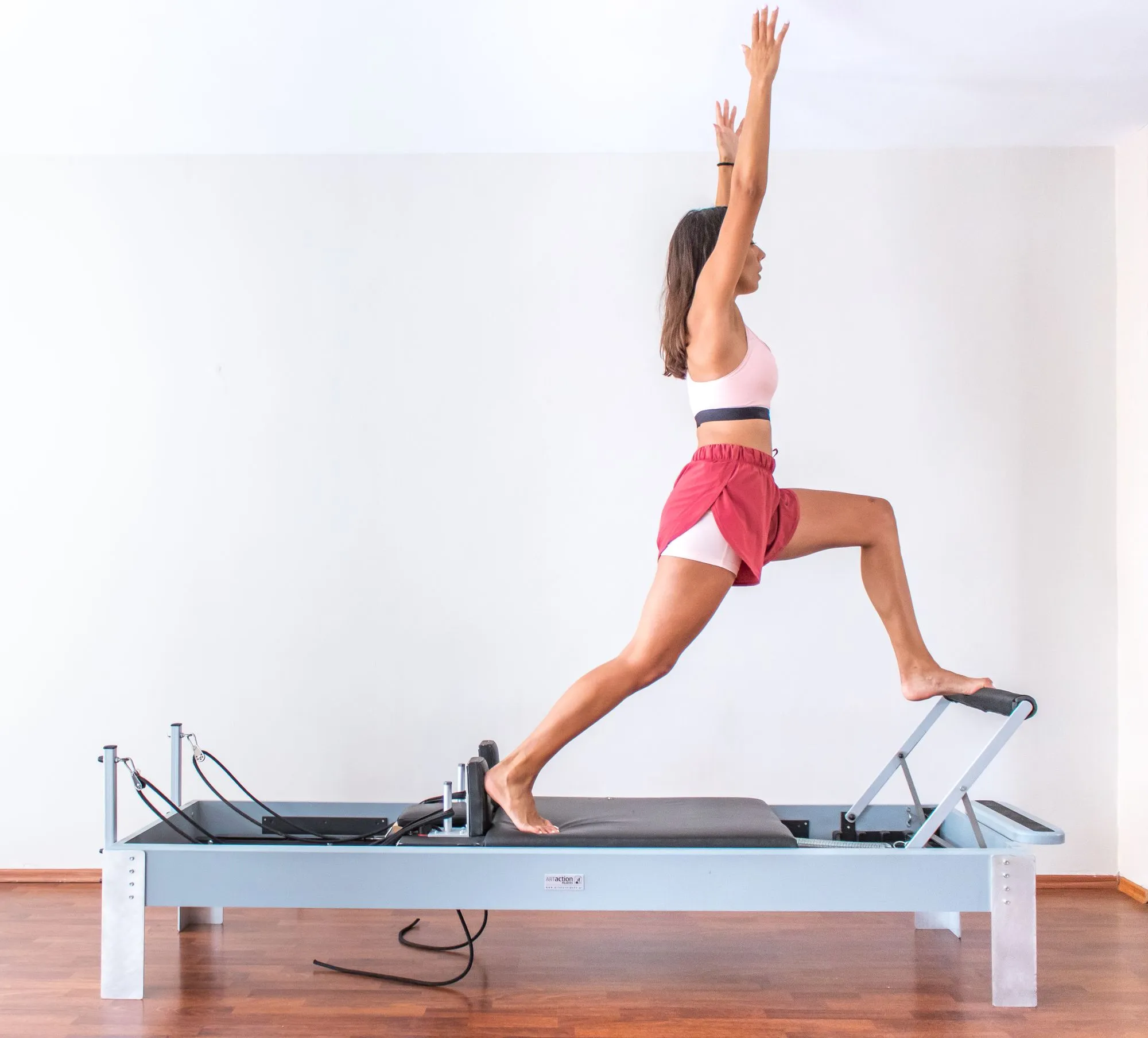
Sculpt takes classic reformer exercises and adds resistance, longer sets and positions that demand stability — such as planks, lunges on the carriage and standing work.
The precision stays the same as in Flow: every repetition has a full range of motion and control of the carriage in both directions. The difference is in the amount of work and how long your muscles stay under tension.
How a class runs
- Warm-up on the barFootwork with a heavier spring setting and core activation.
- Legs and glutes blockLunges, single-leg work and strap exercises — longer sets under constant tension.
- Planks and trunkPlanks on the carriage, oblique work and shoulder stability.
- Arms and backStrap work sitting and kneeling, shoulder-blade and upper-back work.
- Cool-downHip and thigh stretches, with a few calm breaths to finish.
What makes it different
- More resistance and shorter rests than in Flow — you clearly feel your muscles working.
- Strength without jumping or weights: the spring provides the load, and the movement is slow and controlled.
- Taught by Julia Kowal — pace, music and that last repetition you won’t let go of.
Who it suits
A good choice if
- you have a few Reformer Flow classes behind you and know the basic spring settings,
- you want to strengthen your legs, glutes and arms without lifting weights,
- you’re looking for a demanding workout that doesn’t load your joints with jumping,
- you do strength training and want to add control and stability work.
Choose another format or talk to your doctor first if
- it’s your first reformer class — start with Reformer Flow,
- you have a recent injury or acute spine or joint pain — see a specialist first,
- you’re pregnant — choose Prenatal Reformer.
What regular training gives you
- Leg and glute strength
- Long sets under constant spring resistance, including on one leg.
- A stable trunk
- Planks and standing exercises demand work from your whole core.
- Control in motion
- You guide the carriage in both directions, so your muscles also work on the return.
- Gentle on joints
- No jumping and no weights; the load is easy to reduce by changing the spring.
Your first class
- Come after a few Flow classes — it’s easier to focus on the work when you know the equipment.
- Bring water and a small towel; the pace is faster than in Flow.
- If an exercise feels too hard, ask for a lighter spring — that’s completely normal.
- Tell your instructor about any injuries before class.
Frequently asked questions
Can I come to Sculpt without any experience?
It’s better to start with a few Reformer Flow classes. Sculpt is faster, with less time to explain the settings, so it’s easier to get lost.
Is Sculpt strength training?
Yes, in the sense of muscles working against resistance — only the resistance comes from springs instead of weights. The movement is slow and controlled, with no jumping.
How is it different from Jumpboard Cardio?
Sculpt focuses on strength and muscle tension. Jumpboard is jumping on a board while lying down — more about fitness and heart rate.
How often should I do Sculpt?
1–2 times a week works well, alternating with Flow or Mat Core.
Is the first Sculpt class free?
No — the free first class covers Reformer Flow and Mat Core. You can book Sculpt with a single class or a class pack.
Next step
When you want to work on the classical repertoire in an even smaller group, try Tower Control.
These descriptions are for information only and are not a substitute for advice from a doctor or physiotherapist. If you have an injury, a chronic condition or are pregnant, check with a specialist first and tell your instructor before the class.